LETTER TO THE GALATIANS
Defense of Paul's Apostleship
Galatians 2:11-21
CONFRONTING PETER, THE GREAT APOSTLE (2: 11-21)
Introduction
What occurs in these next 11 verses reinforces Paul’s claim in 2:1-10. His apostleship is just as good as that of the original 12. In fact, in the episode before us, we see that Paul’s apostleship is such that he is even able to rebuke Peter. If Paul has the right to rebuke Peter and indeed is right about what he says about Peter, then his apostleship is indeed high. Then his claim to be an apostle is credible because his apostleship is at least on the same level as Peter’s.
To appreciate the significance of this episode, you need first of all to understand the significance of Peter, or as the Roman Catholics and Episcopalians call him, "St. Peter."
At the very beginning of this study, we examined some Scriptures to understand the significance of the apostles for the Christianity. In referring to the apostles, Jesus said: "Whoever receives whomever I send [the apostles] receives Me" (John 13:20). After Jesus asks the disciples who they think He is, Peter replies, "You are the Christ, the Son of the living God." Jesus responds to Peter in the following way (Matt. 16:17-19)?
"________________ are you, Simon Barjona, because flesh and blood did not reveal this to you, but My Father who is in heaven. 18 "I also say to you that you are __________________ [Petros], and upon this ____________________ [petrai] I will build My church; and the gates of Hades will not overpower it. 19 "I will give you the ___________________ of the kingdom of heaven; and whatever ____________ bind on earth shall have been bound in heaven, and whatever ______________ loose on earth shall have been loosed in heaven."
These are high words of praise indeed. First, Jesus claims that because of Peter's correct confession of faith in Jesus, He will build His church upon Peter. Two things here. First, the church is people; therefore, the foundation will also be people. Because Peter is the first to make this confession of faith, he naturally and chronologically would be the foundation of the church. Second, though, you need to understand the significance of Peter for our faith. We have no documents from the hand of Jesus. All these documents come from the apostles. After Peter makes this confession, he becomes the leader of the band of apostles. For that reason his 3-time denial of Jesus really shook the apostles and the early church.
Look now at the role Peter has played in our knowledge of Jesus. NT scholars agree that Peter's account of the life of Jesus is found in the Gospel of Mark. Moreover, modern scholarship claims that both Matthew and Luke to a large degree borrow huge chunks of material from the Gospel of Mark, Peter's gospel. Moreover, Peter will pen 2 letters: 1 and 2 Peter. In other words, 3 of the most important sources of our knowledge of Jesus and 2 minor letters in the NT come from Peter. He was HUGE for the early church and remains huge for most Christians today. Bear this in mind while viewing the following passage.
| 11 But when Cephas came to Antioch, to his face I withstood him because he stood condemned. 12 For before certain men came from James, he used to eat with the Gentiles; but when they came, he began to withdraw and hold himself aloof, fearing those of the circumcision. 13 The rest of the Jews played the hypocrite with him so that even Barnabas was carried away by their hypocrisy. 14 But when I saw that they were not straightforward about the truth of the gospel, I said to Cephas before all, "If you yourself, being a Jew, also live like the Gentiles and not like the Jews, how is it that you compel the Gentiles to live like Jews? 15 "We ourselves are Jews by nature and not sinners from among the Gentiles; 16 nevertheless we ourselves [Jews] knowing that a man is not justified by the works of the Law but through faith in Christ Jesus, even we ourselves [Jews] have believed in Christ Jesus, that we may be justified by faith in Christ and not by the works of the Law; because by the works of the Law all flesh [all persons] shall not be justified. 17 "But if, while seeking to be justified in Christ, we ourselves have also been found sinners, is Christ then a minister of sin? May it never be! 18 "For if I rebuild those things I once destroyed, I prove myself to be a transgressor. 19 "I myself through the Law died to the Law that o God I might live. 20 "Through Christ/with Christ I have been crucified; and it is no longer I who live, but Christ lives in me; and the life which I now live in the flesh I live by faith in the Son of God, who loved me and gave Himself up for me. 21 "I am not nullifying the grace of God, for if through the Law comes righteousness, then Christ died needlessly." |
Commentary
At first all looks good for Paul and his ministry to the Gentile Christians. The great mother church in Jerusalem has settled the matter of the way a person is saved once and for all. But all has not been settled. All the church at Jerusalem has settled is the issue of how a person is saved, not how a person lives the Christian life. OK, so we don’t have to follow the Law of Moses in order to be saved, but do we need to follow the Law of Moses in order to live and experience the Christian life?
On the surface, the issue in this passage seems a little superficial because it revolves around eating, especially what to eat and what not to eat. In the Book of Leviticus, Moses spells out in detail restrictions about the diet the Jew should follow. Although this law was ancient, it was still important for the Jew of Jesus’ day and also for our own present day. There are many OT laws which Jews do not obey; for example, today in Israel the divorce rate is 75%. Yet, they still radically observe the food laws and Sabbath observance. (Whenever a Jew in Jerusalem eats ice cream after a meal served with beef, the ice cream will not be milk based because the OT Law stated you were not to boil beef in the milk of the cow’s mother.) Moreover, one of the great heroes of Judaism is Daniel. What marked him as being so special? The fact that he stood up to the king, Nebuchadnezzar, and refused to eat food from the royal table and insisted on following the strict dietary code of the levitical law.
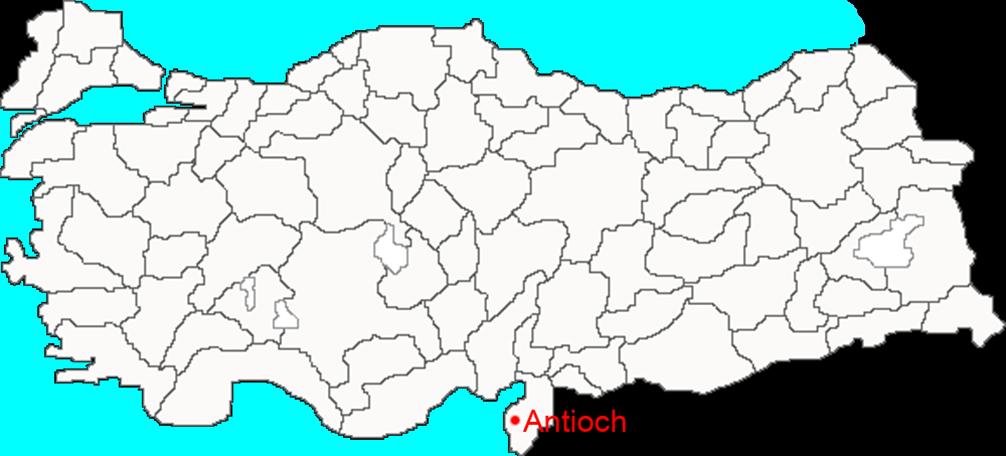
According to this passage, Peter, after the great church conference in Jerusalem, heads up north to Antioch to visit the church there. Peter understandably gets caught up in all the excitement in the Antioch church. People are getting saved. The atmosphere is dynamic because of the freedom they are experiencing in Christ as opposed to the legalism many Jewish Christians are enslaved to in Jerusalem. While Peter is in Antioch, he apparently decides to forego the Jewish dietary laws and eats with the Gentile Christians in Antioch.
(Location of Antioch in modern-day Turkey)
All goes well until a group of Jewish Christians who represent whom (2:12)?
These Judaizers come to Antioch and observe with horror Peter’s actions. Although the person they represented had agreed that a person is saved only by grace, he had nevertheless insisted that Gentile Christians observe some of the Jewish dietary laws, such as, not eating meat that had not been drained of its blood (Acts 15:20). These representatives feel that the Gentile Christians in Antioch are not living up to his instructions.
The result is disastrous. What does Peter begin to do (2:12)?
He, the great apostle, begins to snub the new Christians in Antioch, bowing to pressure from the Judaizers. Not only did the rest of the Jewish Christians in Antioch begin to withdraw from the Gentile Christians, who else was carried away by their hypocrisy (2:13)?
This was the most unkindest cut of all. This man who had been so instrumental in leading many of the Gentiles in Antioch to Christ for salvation—this man began to snub them. For Paul, this was a replay of the assassination of Caesar: “Et tu, Barnabe?” (After this incident, he and Paul split over the issue of whether or not to take John Mark with them on their second missionary journey; it was an issue because John Mark had deserted them on their first missionary journey. His actions here might help explain the tense relationship between Paul and him which led to their division.)
Well, Paul will have none of this. Peter had humiliated the Gentile Christians in Antioch publicly; well, now he was going to get rebuked publicly. Public offense deserves and requires public rebuke. Why? Primarily for the sake of the ones Peter had offended. These were young, immature Christians who might be damaged permanently by Peter’s actions. Paul needs to heal their wounds.
Paul reprimands Peter.
Only a hypocrite could demand of someone something he himself was unwilling to do!
"If you, being a Jew, live like the Gentiles and not like the Jews, how is it that
you compel the Gentiles to live like Jews?” What’s even worse is that Peter
himself had admitted that keeping the Law was impossible not only for
the Gentiles and not only for the Jews of Peter’s day but also for the great Jewish
fathers of the past! No one had ever been able to keep the Law! (Acts 15:10).
15 "We are Jews by nature and not sinners from among the Gentiles; 16 never-
theless knowing that a man is not justified by the works of the Law but through
faith in Christ Jesus, even we have believed in Christ Jesus, that we may be jus-
tified by faith in Christ and not by the works of the Law; since by the works of
the Law no flesh will be justified.”
What is ironic is that Peter himself had appealed to the example of Cornelius who had become a Christian IN PETER’S PRESENCE without being circumcised! Peter knew better! Peter had been preaching to Cornelius, and even before he could get the music director to lead the congregation into the first stanza of “Just as I Am,” lo and behold, Cornelius and his family began speaking in tongues, a sign that the Holy Spirit had come to live within them because they had exercised saving faith in Jesus (Acts 10:44-48; 11:15-17).
17 "But if, while seeking to be justified in Christ, we ourselves have also been
found sinners, is Christ then a minister of sin? May it never be! 18 "For if I re-
build what I have once destroyed, I prove myself to be a transgressor. 19 "For
through the Law I died to the Law, so that I might live to God.
Peter had as much said the same thing at the great church council in Jerusalem:
10 "Now therefore why do you put God to the test by placing upon the
neck of the disciples a yoke which neither our fathers nor we have
been able to bear?
20 "I stand crucified with Christ; and it is no longer I who live, but Christ lives
in me; and the life which I now live in the flesh I live by faith in the Son of
God, who loved me and gave Himself up for me.”
Note that Peter does not contradict Paul nor claim that Paul does not have the right to rebuke him. More might have happened; however, Paul does not record that. From all appearances, it seems like Peter accepted Paul’s rebuke. In fact towards the end of Peter’s life, Peter not only tells his readers to listen to Paul but also elevates Paul’s writings to what level in 2 Pet. 3:15-16?
15 “and regard the patience of our Lord to be salvation; just as also our
beloved brother Paul, according to the wisdom given him, wrote to you, 16
as also in all his letters, speaking in them of these things, in which are
some things hard to understand, which the untaught and unstable distort,
as they do also the rest of the ________________________.”
If Paul was able to rebuke Peter, the great apostle, and also be right about it, and if Peter only not accepted Paul’s rebuke but actually advised his readers to elevate Paul’s writings to the level of Scripture, then surely Paul is an apostle whose apostleship is at least on the same level as that of Peter, the Rock (Matt. 16:18). Moreover, because Paul is an apostle, his gospel comes from Christ Himself. Rejecting Paul’s gospel is tantamount to rejecting Christ.